Find the Serial Number on an AC, Furnace or Heat Pump
Where the data plate sits on an outdoor condenser, a furnace and an air handler, what to copy down, and why the indoor and outdoor units have different serial numbers.
Last updated:
The serial number is on the unit's data plate, a metal or foil label stuck to the cabinet. Heating and cooling equipment is usually a pair of units, an outdoor one and an indoor one, and each has its own plate and its own serial number. Find the plate on the unit you want to date, copy it down exactly, and note which unit it came from. Then, for a Carrier outdoor unit, you can decode it here. For a Carrier furnace or air handler the result is provisional, and for other brands you should ask the manufacturer.
Where to look, in short: on an outdoor unit, the back panel near the refrigerant line connections; on a furnace, inside the cabinet behind the front panel; on an air handler, inside the front door panel for Carrier, and for other brands the cabinet exterior first, then inside the access panel.

Before you open anything
Switch the power to the unit off before you remove any panel. For an outdoor unit that usually means the disconnect box nearby or the breaker; for a furnace or air handler, the switch on or near it or the breaker. Put the panel back when you are done. Some plates can be read without opening anything, so look from outside first.
Outdoor condenser or heat pump
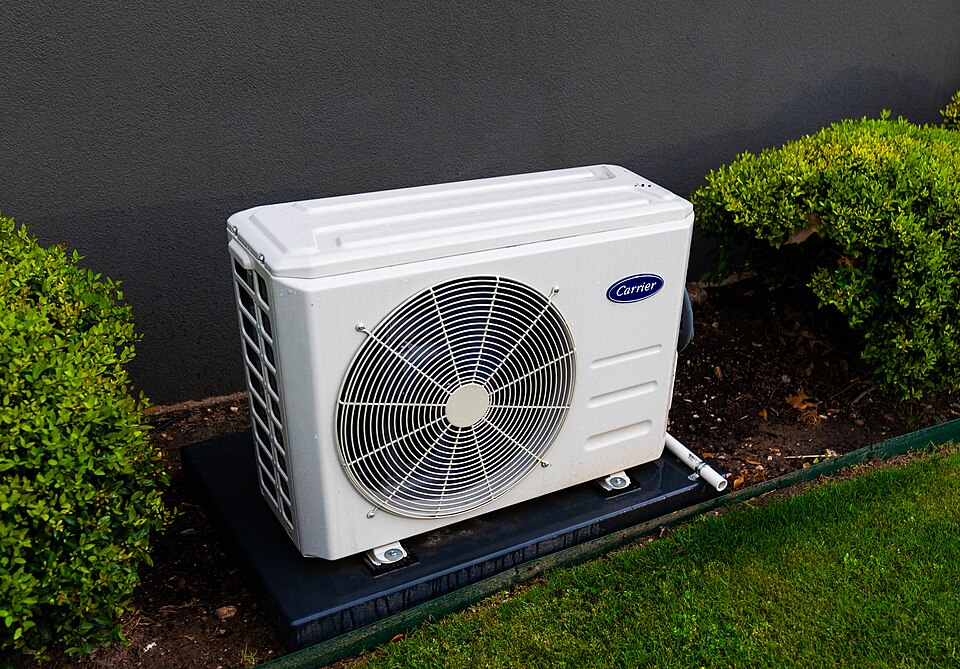
Carrier says the rating plate on an outdoor air conditioner or heat pump is on the back near the service valve connections. Goodman gives almost the same place: slightly above the refrigerant valves on the back side of the unit. The valves are where the copper lines from the house meet the cabinet, so start there. If the plate is not on that panel, check the other sides. Shrubs, grass and a coat of dirt hide a plate easily; wipe it with a dry cloth rather than a wet one.
Furnace
On a furnace the plate is inside. Carrier says the plate on furnaces and air handlers is inside the front door panel. Lennox says to remove the top-front service panel and look on the left side of the interior cabinet or the top of the blower deck, depending on whether the furnace is an 80% or 90% AFUE model. If you don't know which you have, check both spots. Lennox also notes that the furnace's orientation and airflow direction can change where the label is. On Carrier furnaces the front panel is held by knobs: turn them counterclockwise and pull the panel toward you. You only need to take off the outer door or panel, not any internal parts.
Air handler and indoor coil
An air handler is the indoor unit that blows air through the ducts in a system without a gas furnace, such as many heat pump setups. It often sits in a closet, attic, basement or garage. Carrier says the plate on furnaces and air handlers is inside the front door panel: turn the knobs counterclockwise and pull the panel toward you. Other brands vary, and some put the label on an inner wall, so check the outside of the cabinet and then inside the access panel. A separate coil casing may have its own label, and an indoor coil mounted on a furnace may carry one separate from the furnace's.
Can't reach or read the plate?
Try the paperwork first. Goodman says many dealers affix the “traveler label” from the shipping box to the paperwork given to the homeowner after installation, so look in the installation papers or manual envelope for a sticker. If you can reach the plate but cannot read it, take a phone photo with the light angled across it. If you can do neither, give the installer or dealer the model number and your address and ask them to look it up.
This page does not cover ductless mini-split indoor heads, packaged or rooftop units, or horizontal furnaces in attics. For those, check the owner's manual or ask the manufacturer.
Indoor and outdoor units carry different serials
A matched system is assembled from separate pieces: the condenser outside, a furnace or air handler inside, sometimes a coil as well. Each leaves the factory with its own serial number, and they are often not built in the same year. A furnace may be older than the condenser it is paired with, or the other way round, because one of them was replaced.
So a decoded date describes one box. Write down which one it was, outdoor unit, furnace, air handler or coil, before you work out an age. Decode each unit separately and keep the results separate: an old furnace paired with a newer condenser needs different decisions for each. Use the older unit's date only if you need a rough age for the house's original equipment. For lifespan context, see how long air conditioners and heat pumps last and how long a furnace lasts.
What to copy down
Take a clear phone photo of the whole plate first, then copy the details by hand and check them against the photo. Letters and digits get confused easily, so note the characters exactly as printed.
- Brand and which unit it is: for example, "Carrier, outdoor condenser".
- Model number: labelled Model, M/N or similar.
- Serial number: labelled Serial, S/N or similar. Copy every character, including leading zeros and letters.
- Refrigerant label, if the plate has one: copy what it names. It is not needed to date the unit, but a technician will ask.
- A printed manufacture date, if there is one. Use that over any decoded date.
- Where you found it and the date you looked, which helps if you are tracking several units.
Decoding a Carrier serial number
We decode Carrier only, and best for outdoor units. Put the serial into the Carrier serial number lookup, which returns a build year and an age range. The lookup is built from Carrier's documentation for outdoor and rooftop units, though the location guidance on this page does not cover rooftop units. For a Carrier furnace or air handler, treat the year as provisional and check it against a printed manufacture date or with Carrier. We do not decode Bryant, Payne or other brands owned by the same company.
The appliance age finder lists everything we cover. Water heaters are a separate subject; see where to find the serial number on a water heater.
If the brand is not Carrier
Do not trust a chart you cannot trace to the manufacturer. Many sites publish serial "decoders" with no source, and a wrong rule gives a confident wrong age. Instead:
- Look for a printed manufacture date on the plate. Some plates have one, in which case there is nothing to decode.
- Look on the manufacturer's own website for a serial or warranty lookup.
- Contact the manufacturer or an authorised dealer with the model and serial numbers and ask for the build date.
Once you have a build year from any trustworthy source, the equipment remaining life calculator compares it with typical lifespans. A build year can be a little earlier than the install year, so treat the age as approximate.