How Long Do Air Conditioners and Heat Pumps Last?
InterNACHI's chart gives a central air conditioner 7 to 15 years and a heat pump 10 to 15 years. Here is how to read those ranges, check your unit's age and spot signs of wear.
Last updated:
InterNACHI's Standard Estimated Life Expectancy Chart for Homes lists a central air conditioner at 7 to 15 years and a heat pump at 10 to 15 years. Those are the two numbers most people are after. They describe a planning range for a whole category of equipment, so they cannot say when your unit will stop. To use them, you first need to know how old your unit is. These ranges are for central systems. The same chart gives a window air conditioner 5 to 7 years. Every lifespan figure on this page comes from InterNACHI, a home inspectors' trade association, so treat them as one source's planning guide.

What the ranges say
The chart has one line for each: "Air Conditioner (central)" at 7 to 15 years and "Heat Pump" at 10 to 15 years. A heat pump's range starts higher, but both end at the same age. The chart does not explain why the air conditioner range is so wide. It does not say which kinds of heat pump the line covers, so do not assume it fits every type. InterNACHI does say that life expectancy varies with usage, weather, installation, maintenance and quality of materials, and that the figures assume regular recommended maintenance rather than neglect or extreme conditions. It calls the list a general guideline, not a guarantee or warranty.
InterNACHI's separate chart for Florida homes gives a central air conditioner 5 to 12 years, against 7 to 15 on the national chart, so where you live can shift the range.
Check your unit's age first
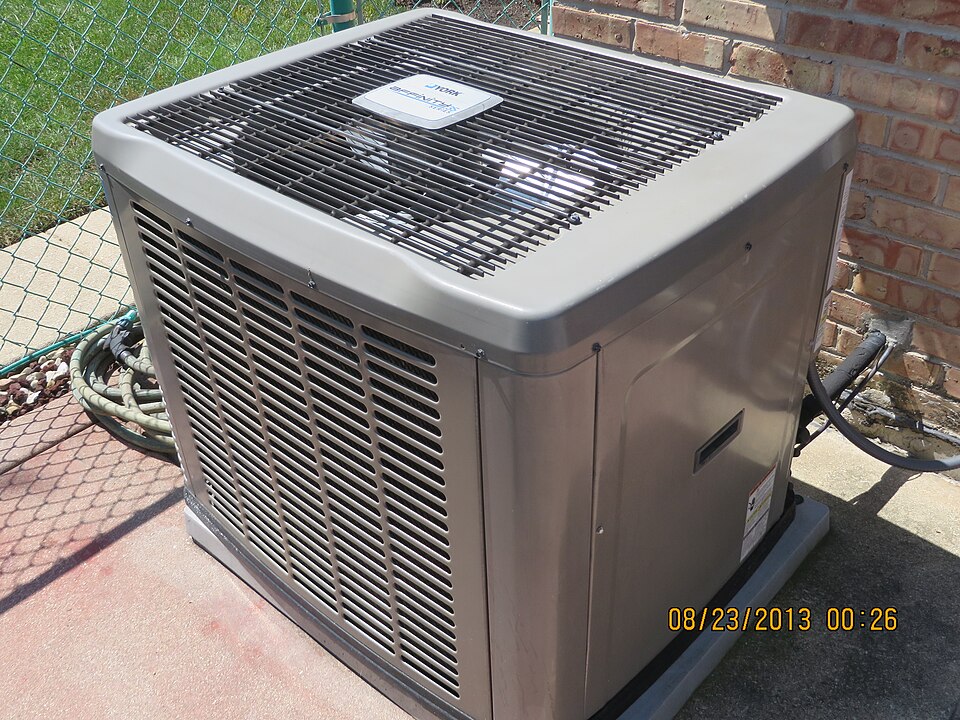
A lifespan range only helps against a real age. The build date is usually on the data plate, a label on the outdoor cabinet of a central air conditioner or heat pump. Look for the serial number and model number there. The guide to finding the serial number on an AC, furnace or heat pump shows where the label usually sits and what to copy down.
If the label says Carrier, the Carrier serial number lookup turns the serial into a build year. It is built for outdoor and rooftop units, so don't rely on it for an indoor air handler. For other brands, look for a printed manufacture date on the plate, or ask the manufacturer with the model and serial numbers.
Two things to remember. The build year can be earlier than the installation year, because equipment may sit in a warehouse first. And in a split system the outdoor unit and the indoor coil may have been installed in different years, so check both labels if you can.
A worked example, with made-up numbers: an outdoor unit built in 2012 and checked in 2026 is 14 years old. That sits near the top of both ranges, so it is time to start planning, not a prediction that it fails this summer.
With a build year in hand, the equipment remaining life calculator compares it with a range and shows how much of it has been used.
Signs it may be time to talk to a technician
None of these comes from InterNACHI's chart, and none proves a unit is worn out. Some point to a fixable fault, and they count for more together than alone.
- Repairs are coming closer together. One repair is normal. A run of them suggests the whole system is tiring.
- It runs a lot but the house stays warm, or some rooms never cool properly.
- Noise has changed, such as grinding, squealing or loud rattling from the outdoor unit.
- Short cycling, where it starts and stops again quickly.
- Ice, leaks or visible corrosion on the unit or its lines. These can be a fault rather than age. On an air conditioner, if the indoor coil or refrigerant lines are iced, switch the system off and let it thaw before calling a technician. On a heat pump, a thin layer of frost on the outdoor unit in cold, damp weather is normal because the unit defrosts itself. Call a technician if it is encased in thick ice, stays iced after a defrost cycle, or stops heating.
- Weak or no heat in winter, if you have a heat pump.
- Parts are hard to get for an older model. Ask the technician.
A burning smell, tripped breakers or a unit that will not stay on are electrical or safety matters. Switch the system off and call a qualified technician rather than waiting.
Age is not condition
The range describes a group of units, not yours. A well-installed, well-serviced unit may run past the top of the range, and a poorly installed one can fall short of the bottom. A technician's inspection tells you more about remaining life than the build year does. Use age to decide when to start asking questions, and condition to decide what to do.
If the data plate says R-22, it is an older unit. EPA's phaseout table lists 2020 as the year of no production or import of HCFC-22 (R-22), though it notes that some uses continue, such as servicing air-conditioning equipment. Before paying for a repair that needs refrigerant, ask the technician what it would involve and cost.
When a unit is near the top of its range, ask for the quote in writing with the failed part named, ask about the refrigerant type, and ask whether the indoor coil and outdoor unit are close in age. Get a second opinion before a large expense.
Furnaces have their own range and their own signs, covered in how long a furnace lasts.